Opinion
Why Jensen Huang will be reinstated as Nvidia CEO
Nvidia's board accepted a resignation. It did not name a successor, give a reason or close the door. Precedent, Asia and the tape all point the same way.

Opinion. This is the author's argument, not the desk's reporting. The facts in it are sourced below.
The word that matters in Nvidia's announcement is "interim." Colette Kress is interim chief executive. She is still chief financial officer. The board says it is starting a search and will weigh "internal and external candidates," which is what a board says when it has nobody.
I think the search ends where it began. My forecast, written so it can be scored: Jensen Huang will be chief executive of Nvidia again within twelve months.
This is an opinion. It is not the desk's reporting, which is in the timeline, and it is not a recommendation to buy or sell anything. Prices are as of 1:03 p.m. Eastern on Thursday.
What the board did not do
Read the filing. The board "accepted the resignation." It gave no reason. It left out the customary sentence saying a departure involved no disagreement with the company, a sentence Nvidia did use when a director left in January. It is silent on separation terms and on his unvested stock. The release thanks him for "immeasurable contributions."
Four days earlier the same directors said they had "no reason to believe that either national security or NVIDIA secrets were compromised" and that "the Board has confidence in Jensen and his leadership team." The investigation they ordered, led by the former federal prosecutor Joon H. Kim of Wachtell, Lipton, has reported nothing. The board did not say he was fired. It did not announce a finding. It took a resignation on Wednesday, the same night The Wall Street Journal reported it was preparing to oust him.
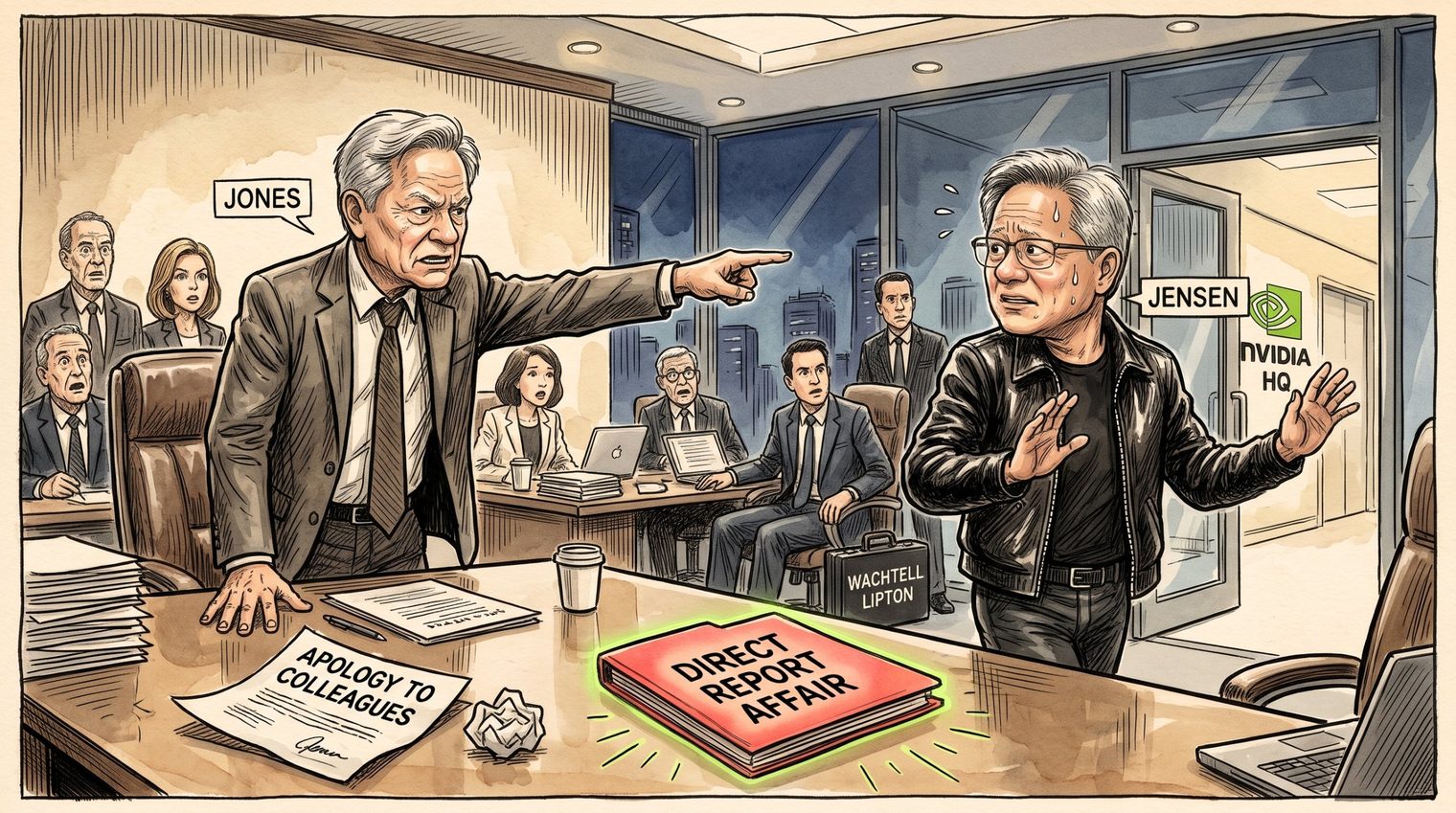
You do not leave every term blank when a story is over. You leave them blank when it is not. That is my reading, and the blanks could just as easily mean the lawyers are still arguing. Either way, nothing on the record closes the door, and he still owns about 3.4% of the company, according to his last ownership filing.
Investors are mathematicians, not moralists
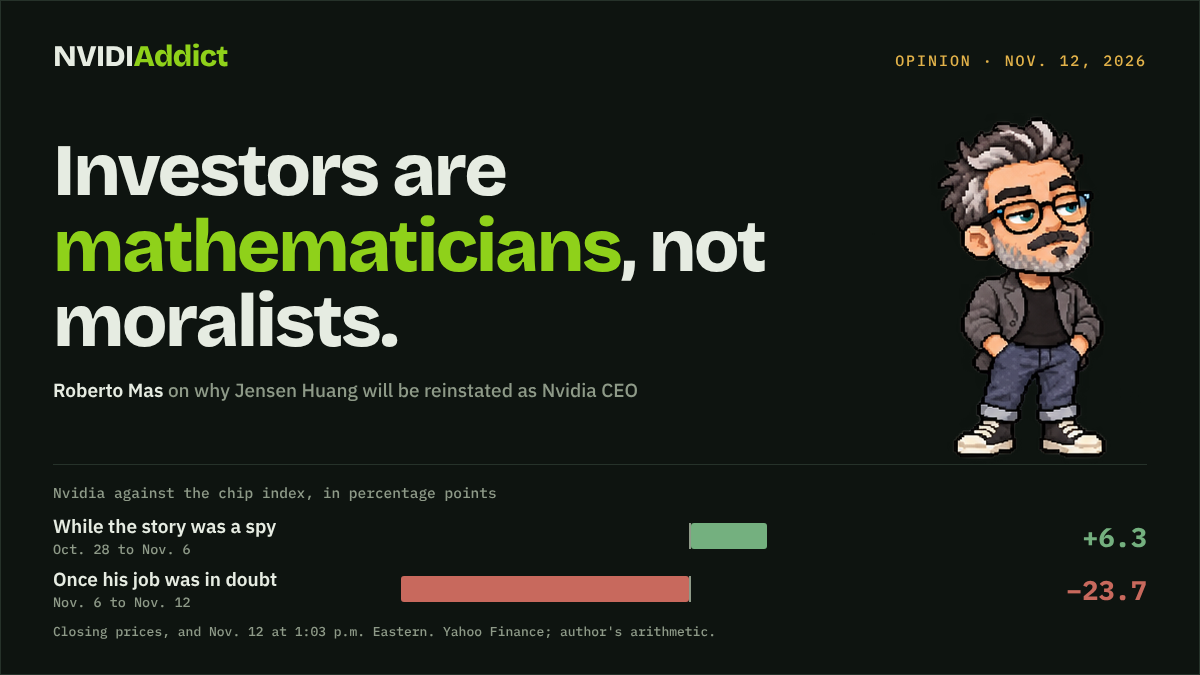
On Oct. 29, the day The New York Times reported that American officials saw Huang as the target of a Chinese intelligence operation, Nvidia closed down 0.8%. On Nov. 12, the day the company said he was gone, it opened down more than 13%.
That is the argument in two numbers, and the longer record says the same thing. From the last close before the spy story through Nov. 6, Nvidia fell 13.3% and the chip index fell 19.6%. For seven sessions, with the allegation in every newspaper, the stock held up better than its sector. Then Huang told employees about an affair, his job came into question, and the relationship flipped. From the Nov. 6 close to 1:03 p.m. Thursday, Nvidia lost 11.6% while the chip index gained 12.1%.
Had Nvidia kept pace with the index since Nov. 6, it would be near $209. It was $164.98. Across about 24.1 billion shares, that gap is a little over $1 trillion. The arithmetic is mine, from Yahoo Finance prices for Nvidia and the PHLX Semiconductor index, and it is an estimate. It is also the best number anyone has for what the market thinks Jensen Huang is worth to this company.
The analysts said it in plain words. Bernstein's Stacy Rasgon cut the stock while writing that "the fundamentals of the business (if not the leadership) are clearly still intact." Oppenheimer's Rick Schafer called a departure "a material, potentially thesis-changing event." The downgrades I have read are about the vacancy, not the spy. The research says this is normal: markets read the forced exit of an outperforming chief as a bad sign, and they react badly when no clear reason is given.
Investors are mathematicians, not moralists. They did not sell because a spy story ran, and they did not sell because a married man had an affair. They sold when the arithmetic changed. The people closest to the work did the same sum: in a Blind poll taken Nov. 9 and 10, 88% of 232 Nvidia employees said he should stay and 1% said the board should remove him, Investing.com reported.
One caution about my own evidence. The stock touched $148.80 after the open and was back near $165 by early afternoon. I will not pretend that bounce is a bet on his return. Some of it is bargain hunting, and some is relief that the waiting is over. What the tape does prove is the price of his absence. The market likes him, and it has said so with a trillion dollars. There is one inexpensive way for the board to get that money back.
Boards blink, and founders come back
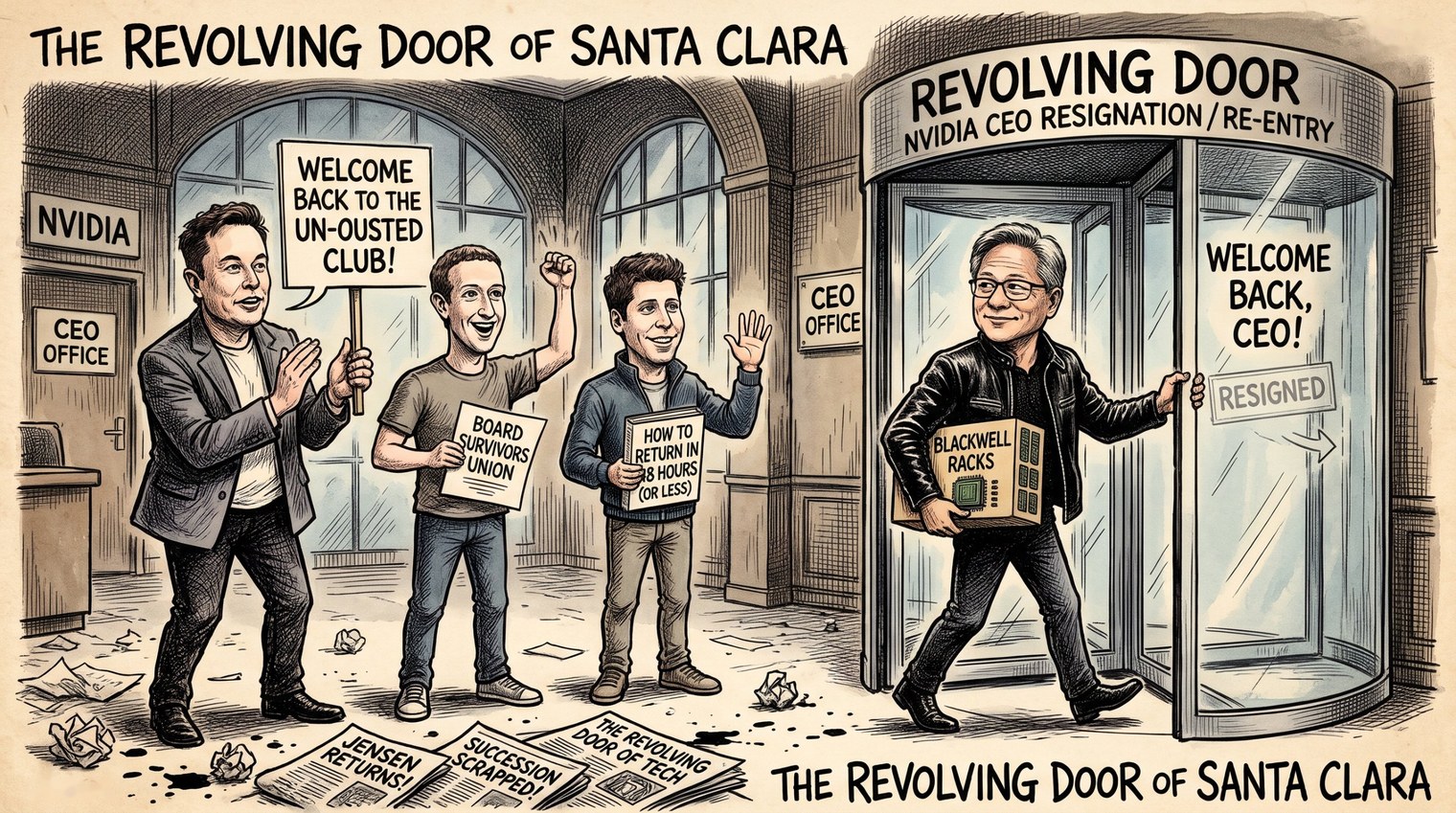
Sam Altman. OpenAI's board fired him on Nov. 17, 2023, saying he had not been "consistently candid." By Monday Microsoft had hired him, and an estimated 97% of the staff had signed a letter threatening to quit, NPR reported. By Tuesday night the board had agreed to take him back. Less than four months later a law firm that had reviewed more than 30,000 documents concluded that his conduct "did not mandate removal."
Now look at Nvidia's week. A board moved fast, under press pressure, before its own investigation had reported. The workforce is on record. A rival bidder has appeared: Elon Musk said Wednesday that it would be an "honor" to hire Huang, Forbes reported. OpenAI's directors learned what a founder is worth when Microsoft made the same offer.
Elon Musk. In 2018 the Securities and Exchange Commission sued in a case that could have barred him from running any public company. The settlement came within days. It cost him the chairmanship for three years and $20 million. He stayed chief executive, and Tesla put an independent chair above him. Seven years later roughly 75% of voting shares approved a pay plan valued at nearly $1 trillion to keep him, with both big proxy advisers urging a no vote. Mathematicians.
Nvidia had never had a chair. On Wednesday night it created one. The structure for a founder under supervision now exists, and it is the one the Georgetown professor Jason Schloetzer described to Fortune a day before the resignation: "I don't expect a 'stay or go' decision. It will be more like a 'stay, with less.'"
Mark Zuckerberg. He is the control case, the founder who cannot be fired. He holds 61% of Meta's votes on 13% of its stock, according to a shareholder filing. In 2021, by the proponents' count, 52% of the outside votes went for putting an independent chair over him. It failed, and he still runs the company. Huang has no such armor. He has ordinary shares and a small minority of them. If he comes back, it will be because the owners want him, and that is a stronger mandate than supervoting stock.
And beyond. The list of leaders who left and were asked back is long, and it includes the man who built the factory Nvidia depends on.
| Who | How he left | How he came back |
|---|---|---|
| Sam Altman | Fired by OpenAI's board, 2023 | Reinstated four days later |
| Morris Chang | Handed over TSMC, 2005 | Reappointed by the board in 2009, at 78 |
| Steve Jobs | Left Apple, 1985 | Returned 12 years later |
| Jack Dorsey | Removed by Twitter's board, 2008 | Returned in 2015 |
| Michael Dell | Stepped down at Dell, 2004 | Returned three years later |
| Howard Schultz | Stepped down at Starbucks, 2000 | Returned in 2008, and again in 2022 |
| Bob Iger | Stepped down at Disney, 2020 | Returned two years later |
The dates are from NPR and Fortune.
Then look at who sits across the table from Huang in Seoul. Lee Jae-yong of Samsung was convicted of bribing a president and served 18 months. He was pardoned in August 2022 by a government that said it was acting "to overcome the economic crisis by vitalizing the economy," and two months later he was executive chairman. Chey Tae-won of SK was sentenced to four years for embezzlement in 2013, pardoned in August 2015 and in his office the next day.
Those were crimes, proved in court. Huang has not been accused of one, Reuters notes. I am not holding up pardons for tycoons as good governance. I am pointing out what boards and governments do when one person is bound up with a national champion. They find a way.
The Asia only he carries
Huang was born in Tainan and left at nine. He speaks Taiwanese on the street, and Taiwan has a word for what happens when he lands: Jensanity. On a 2024 visit he walked a Taipei night market with Morris Chang.
Chang's memoir describes a friendship of more than two decades. In 1998, when Nvidia was short of staff, TSMC sent two production people to help. Huang, Chang wrote, was willing to bet everything on TSMC. In 2013 Chang asked him to run TSMC. The answer, as Reuters reported it: "I already have a job."
In Seoul last year he took Lee and Hyundai's Chung Eui-sun out for fried chicken and beer, paid for the whole restaurant, and left a signed note: "To our partnership and the future of the world." The same week Nvidia said it would supply more than 260,000 processors to Korean companies, Fortune reported. When Huang wanted SK Hynix's next memory chip six months early, it was SK's chairman, Chey, who told the world.
Those are not corporate relationships. They are his. Reuters asked the supply chain what it thinks. An executive at a Taiwan supplier: "We will support whatever capacity Nvidia needs, but the new CEO may not be as aggressive as Jensen." An official at a Korean chip company said the biggest question there is whether a successor would keep the same relationship. The analyst Ming-Chi Kuo: "He can take technologies his engineers believe are possible and turn them into products." Counterpoint's Neil Shah: "Without him at the helm, we will likely see a slowdown in new, aggressive ecosystem-level investments." Shares of TSMC and SK Hynix both fell in Asia on Thursday.
A successor inherits the contracts. A successor does not inherit the dinners, the language or the twenty years.
I know the obvious reply. Asia is also where the trouble started. That is a reason for a chair, an investigation and rules about who the chief executive sees. It is not a reason to hand the most important supplier relationships in technology to someone those suppliers have never met.
There is no one else
Huang never named a successor, Reuters reports. Nvidia's own annual report lists failed succession planning as a risk and says the company is highly dependent on its longstanding executive team. Dozens of executives reported straight to him, according to Fortune. The company was built as one man's nervous system.
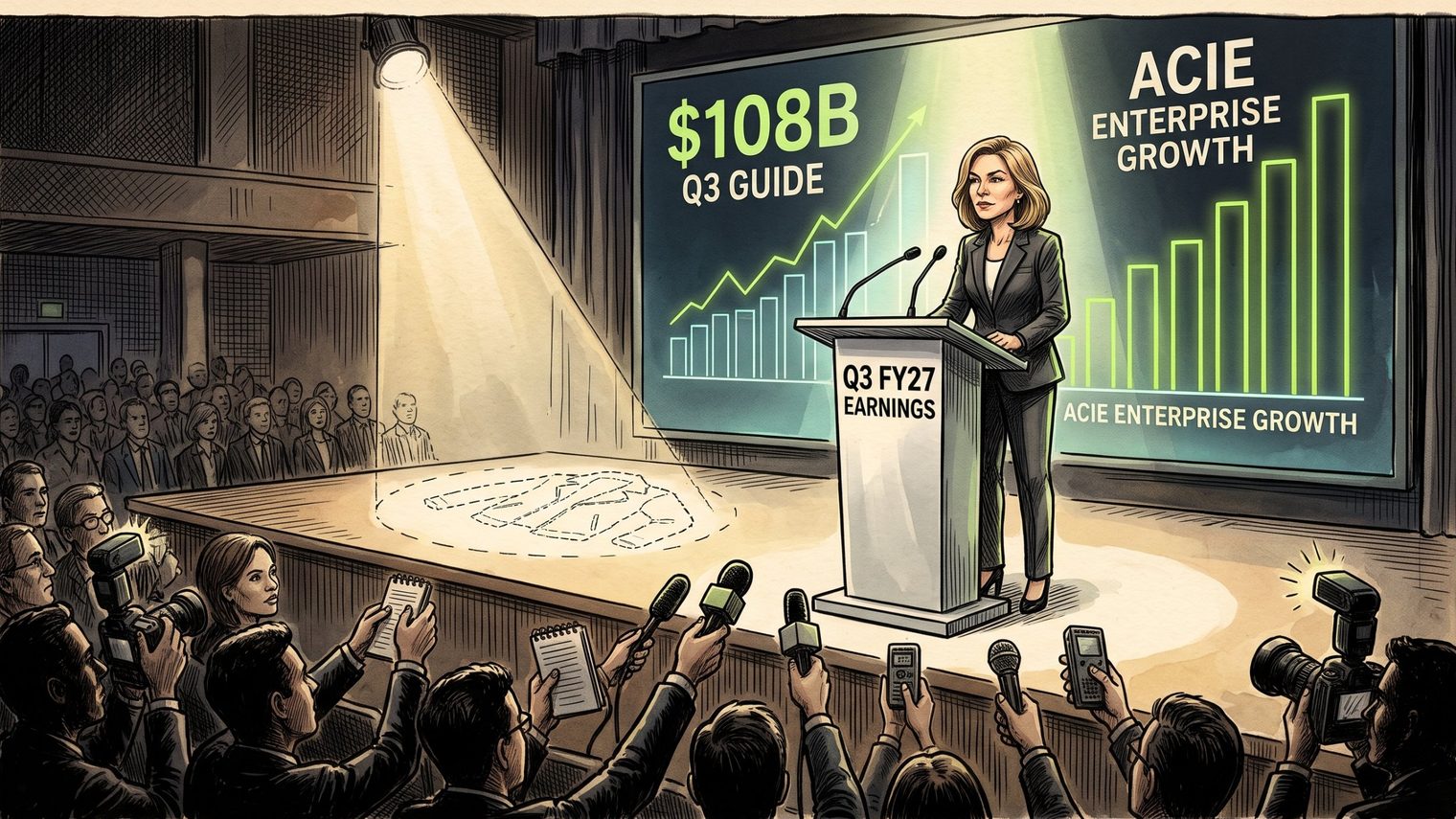
Kress is good. D.A. Davidson's Gil Luria told Reuters she "is well respected by investors and should be able to guide NVIDIA through this challenging period." I agree. She is also doing two jobs five days before earnings, and her own board's release calls her interim.
Now the names, as Reuters and Forbes collected them. Ian Buck led the development of CUDA, and analysts told Forbes he lacks broad operating experience. Rene Haas runs Arm. Lisa Su runs AMD, Nvidia's main rival. Jay Puri retired in July. Eric Schmidt left Google's top job long ago. President Trump has proposed Tim Cook, now Apple's executive chairman, with the line "A Legend replaces a Legend!" Forbes had no comment from Cook or Apple to report.
Michael Monaghan of Founder ETFs put it to Fortune before the resignation: "We don't really believe there is such a thing as succession in these massive founder-led companies." His firm said it would sell if Huang left.
The best argument on the other side comes from Shay Boloor of Futurum, who told Reuters: "I don't see the next 12 to 18 months of revenue suddenly disappearing if Jensen were to leave." He is right, and it helps my case. The chips for the next year or two are already designed and in production, as a fund manager told Reuters. That gives the board time to let the investigation finish. Boloor's worry is the decade after that, and nobody on the list above solves it.
The case against me
Conduct exits do not reverse. Brian Krzanich at Intel, Steve Easterbrook at McDonald's, Bernard Looney at BP and Harry Stonecipher at Boeing all left over relationships, and none came back. True. None of them founded the company he ran, and none of those exits cost shareholders a trillion dollars.
Returning chiefs underperform. Researchers who studied 167 of them at large American companies over 25 years found annual stock performance more than 10% lower than under first-time chiefs, and Fortune's account of the work says the effect was worse for founders. I take that seriously. The famous returns came after years away, to companies that had changed: Jobs after twelve, Dorsey after seven. A return measured in weeks is a reversal, not a comeback. Altman is the comparison, not Schultz.
Candor. Schloetzer again: "Boards remove CEOs over candor issues." Shareholders have sued, alleging the company's earlier statements misled them. Two House chairmen have said subpoenas are likely. If Kim's investigation finds that Huang misled his board, or that anything controlled left the building, he is finished and he should be.
The president has another idea. On Monday Trump said Huang "had absolutely no idea" the woman was a spy. On Thursday he was pitching Cook. Read the pitch again, though. The second legend in that sentence is Huang.
He may not want it. He has said nothing about the resignation. When the Times reached him Wednesday, Forbes reports, he said, "I don't think you should be talking to me directly," and hung up.
How it happens
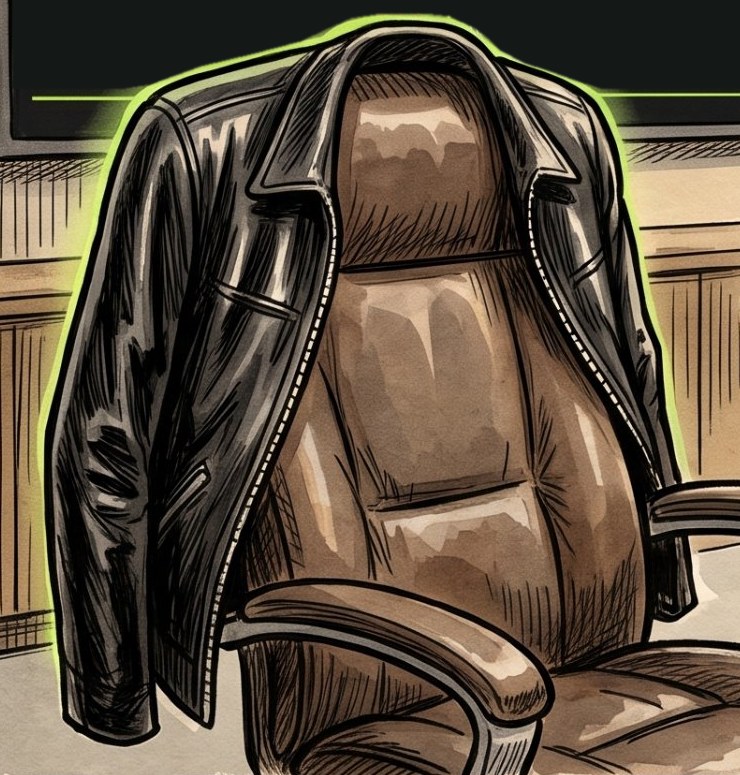
First, the investigation reports. If the board's sentence of Nov. 8 survives, "no reason to believe" becomes "no evidence," and the stated reason for doubt is gone.
Second, the structure is already built. He returns as chief executive under a chair, with conditions, which is the Musk settlement and "stay, with less" in one move.
Third, the mechanics are a single meeting. Under Nvidia's bylaws a majority of directors can fill a board vacancy, and the board appoints the chief executive. No shareholder vote is required, though Musk has backed holding one once the investigation ends.
Fourth, the pressure only builds: earnings on Tuesday, a search with no obvious name, suppliers asking questions in Taipei and Seoul, and a trillion dollars waiting on the other side of one decision.
If the investigation finds a breach, that is a fact, and the math changes. If all it finds is an affair, that is a moral judgment, and the owners have already told the board what they think it is worth.
Roberto Mas is the publisher of NVIDIAddict. He owns 4.58 shares of Nvidia. This piece is his opinion alone.
Sources
- NVIDIA Announces CEO Transition NVIDIA, 2026-11-12
- Form 8-K: departure of Jen-Hsun Huang; appointment of interim CEO and Chair NVIDIA Corporation, SEC filing, 2026-11-12
- Form 8-K: resignation of director Persis Drell (copy) NVIDIA Corporation, via Boardroom Alpha, 2026-01-23
- Statement From NVIDIA Board of Directors NVIDIA, 2026-11-08
- Statement From the Independent Members of the NVIDIA Board NVIDIA, 2026-11-10
- A Message to Our Company NVIDIA, 2026-11-08
- Nvidia preparing to oust CEO Jensen Huang, WSJ reports Reuters, via Yahoo Finance, 2026-11-11
- Form 4: Jen-Hsun Huang, transactions of Sept. 16 and 17, 2026 SEC filing, 2026-09-18
- Annual report for fiscal 2026 (Form 10-K) NVIDIA Corporation, SEC filing, 2026-02-25
- Amended and Restated Bylaws NVIDIA Corporation, 2024-03-12
- NVIDIA Announces Financial Results for Second Quarter Fiscal 2027 NVIDIA, 2026-08-26
- Nvidia Chief Seen as Target of Chinese Spy Plot The New York Times, via GV Wire, 2026-10-29
- NVDA historical prices Yahoo Finance, 2026-11-12
- PHLX Semiconductor index historical prices Yahoo Finance, 2026-11-12
- Wall Street reacts: Bernstein and Oppenheimer downgrade Nvidia Investing.com, 2026-11-12
- Oppenheimer downgrades Nvidia on CEO departure reports Investing.com, 2026-11-12
- CEO Turnovers: Transparency of Announcements and the Outperformance Puzzle Farah and Li, International Journal of Financial Studies, 2021
- Nvidia employees overwhelmingly want Huang to remain CEO despite spy affair Investing.com, via Yahoo Finance, 2026-11-11
- Jensen Huang resigns from Nvidia; Trump says Tim Cook should replace him Forbes, 2026-11-12
- 'Stay, with less': why Nvidia's board may rein in Jensen Huang rather than fire him Fortune, 2026-11-11
- Who would be next CEO at Nvidia? Reuters, via Investing.com, 2026-11-12
- Instant view: Nvidia CEO Jensen Huang steps down Reuters, via Investing.com, 2026-11-12
- Analysis: Investors worry the AI trade needs Nvidia's Huang and its largesse Reuters, via KFGO, 2026-11-12
- Nvidia's Asian supply chain prepares for life after Huang Reuters, via SRN News, 2026-11-12
- Explainer: the legal exposure for Nvidia and Huang Reuters, via Insurance Journal, 2026-11-12
- Nvidia and Huang face lawsuit alleging investors were misled Associated Press, via PBS News, 2026-11-10
- Congress to call Jensen Huang in to answer TechCrunch, 2026-11-11
- Trump: Jensen Huang had no idea UPI, via Yahoo, 2026-11-09
- Sam Altman officially reinstated as OpenAI CEO Fortune, 2023-11-29
- OpenAI reinstates Sam Altman as its chief executive NPR, via KUNC, 2023-11-22
- Review completed and Altman, Brockman to continue to lead OpenAI OpenAI, 2024-03-08
- For companies, rehiring a founder can be enticing, but the results are usually worse NPR, 2023-11-21
- Bob Iger joins the ranks of boomerang CEOs Fortune, 2022-11-21
- Elon Musk and the SEC reach a settlement Axios, 2018-09-29
- Tesla shareholders approve $1 trillion pay package for Elon Musk TechSpot, 2025-11-07
- Notice of exempt solicitation, Meta Platforms 2024 annual meeting Illinois State Treasurer and co-filers, SEC filing, 2024-05-17
- Notice of exempt solicitation, Meta Platforms 2022 annual meeting Illinois State Treasurer and co-filers, SEC filing, 2022-04-25
- Morris Chang returns as TSMC chief executive Taipei Times, 2009-06-15
- Samsung heir Jay Y. Lee pardoned to help overcome economic crisis Bloomberg, via Fortune, 2022-08-12
- Despite legal troubles, Samsung names Lee as chair Associated Press, via Manufacturing Business Technology, 2022-10-28
- Pardoned SK Group chairman gets back in office Korea JoongAng Daily, 2015-08-16
- Like a pop star, Nvidia's CEO Huang stirs up 'Jensanity' in Taiwan Reuters, via The Star, 2024-06-05
- TSMC founder Morris Chang offered top job to Jensen Huang, memoir shows Reuters, via The Star, 2024-11-29
- Three billionaires dropped by a fried chicken joint. Jensen Huang bought everyone dinner Fortune, 2025-10-31
- Nvidia's Huang asked SK Hynix to bring forward supply of HBM4 chips by 6 months, SK's chairman says Reuters, via The Star, 2024-11-04
- Gates, Looney, Easterbrook: ushered to the exit over work relationships AFP, via 24 News HD, 2023-09-14
The desk, live.
Crash risk you can move, five scenarios with your own odds, the daily digest and its scored record.